
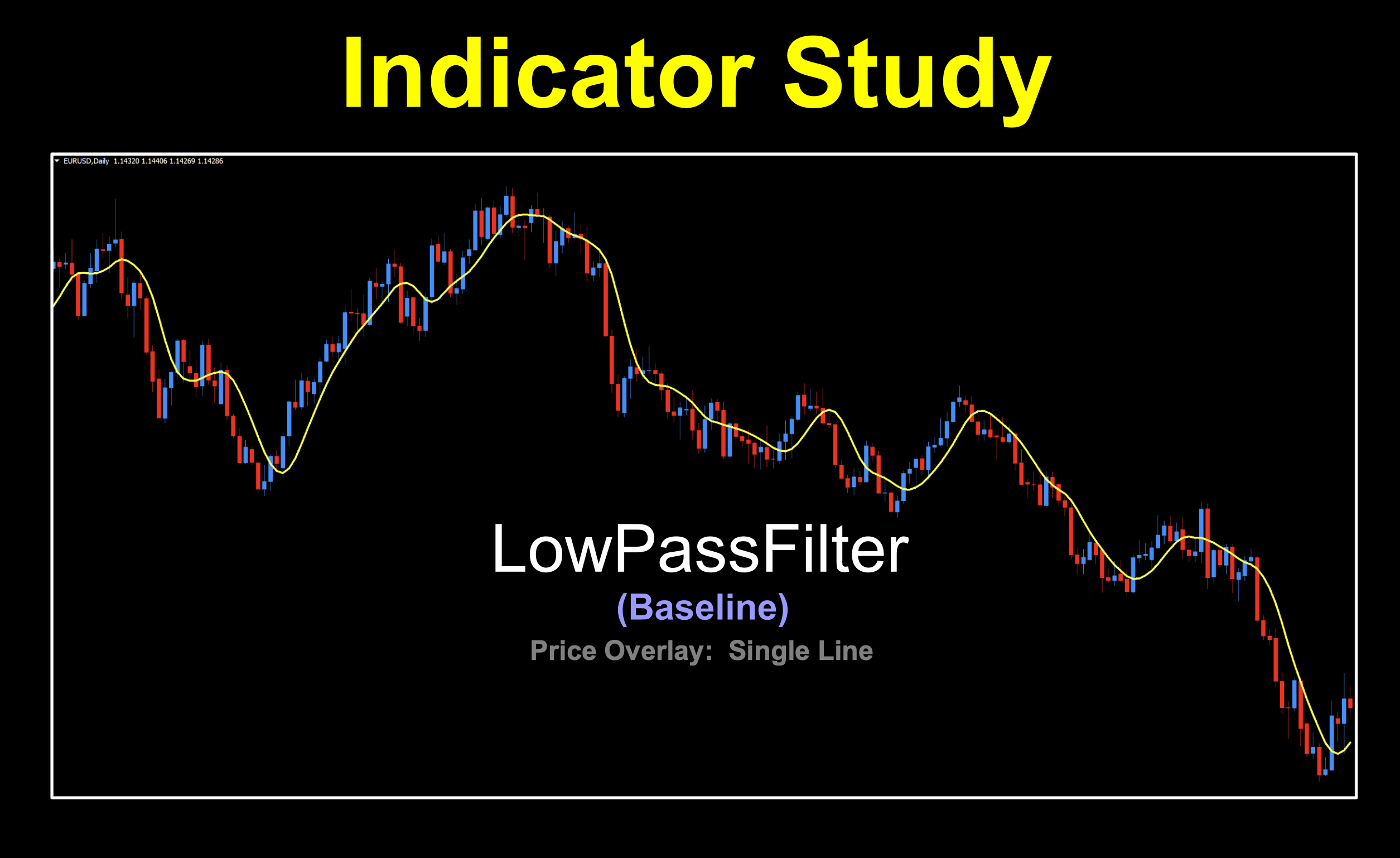
Boring is Fine
Yeah, baselines are on the boring side. But, they do provide the fundamental understanding of where price is going. Above, it’s going up and below, going down. Nothing special here. The trick is to find baselines that can read the market’s mood and provide us the best possible signals.
Squirrel Moment

The first paragraph actually triggered a memory a trader shared with me many years ago. It became a core memory and one I share with new(er) traders who don’t really know what to expect. It also serves as a “self-help” of sorts. Since it taps into the psychology of trading, I felt it valued enough to share.
Trading should be boring.

Yep, you read that correctly. If you imagined trading like in the movies where everybody is wired to the gills, screaming in a chaotic, fast paced environment fueled by ever changing trading boards, and people running around, it’s not ideal.
Even siting at a desk by yourself with your eyes popping out of your head as you make split second decisions; opening and closing trades trying to capture every change in market direction to squeeze every last pip out of each move…well, as the song goes; dream on. Keep it boring. You will live to trade another day and probably prevent burnout and/or blowing up your account. Now back to our regularly scheduled profile…

Good Stuff
This is actually a well-written implementation of a filter type signal line from 2007. It’s not just a moving average—it uses recursive digital IIR (Infinite Impulse Response) filters, similar to Butterworth filters described by John Ehlers.
And?
It also uses digital filtering to smooth price data and reduce market noise. Unlike a traditional moving average, it removes many small, random price fluctuations while preserving the overall trend, making trend direction easier to identify. Features including:
- An optional moving average can be applied before filtering.
- An adaptive noise filter can ignore insignificant price changes based on recent market volatility.
This helps reduce false signals while highlighting meaningful market moves.
Default
Looking at the default view, the signal line paints a pretty picture.
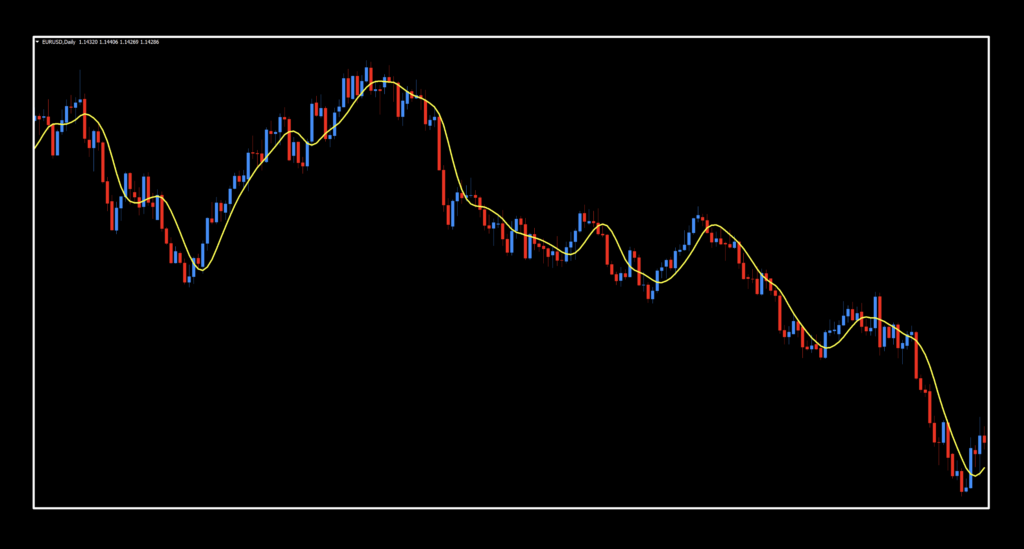
But when you start to take a closer look, you’ll see that on the default settings, it follows price a little too closely as noted below.
Busy, Busy, Busy
Tweaker
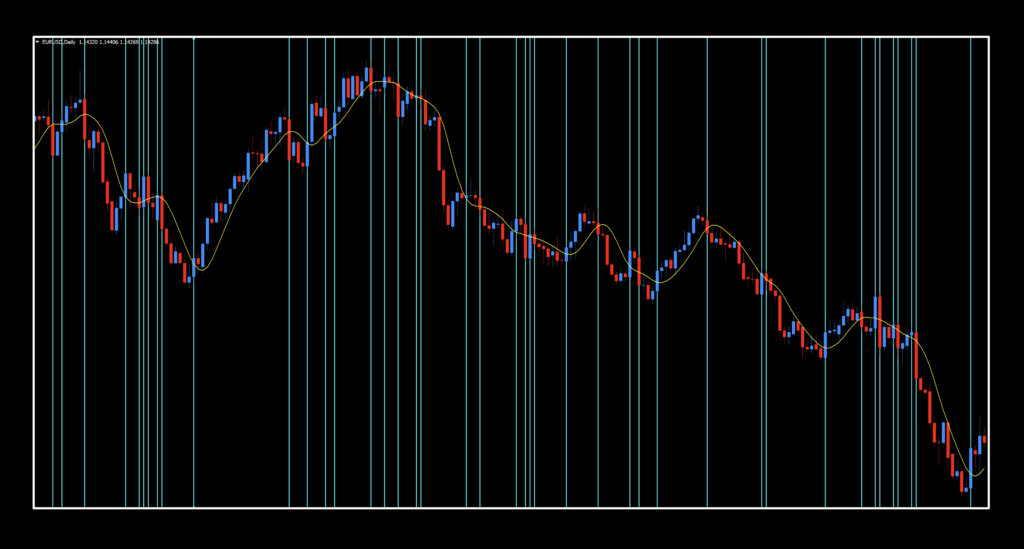
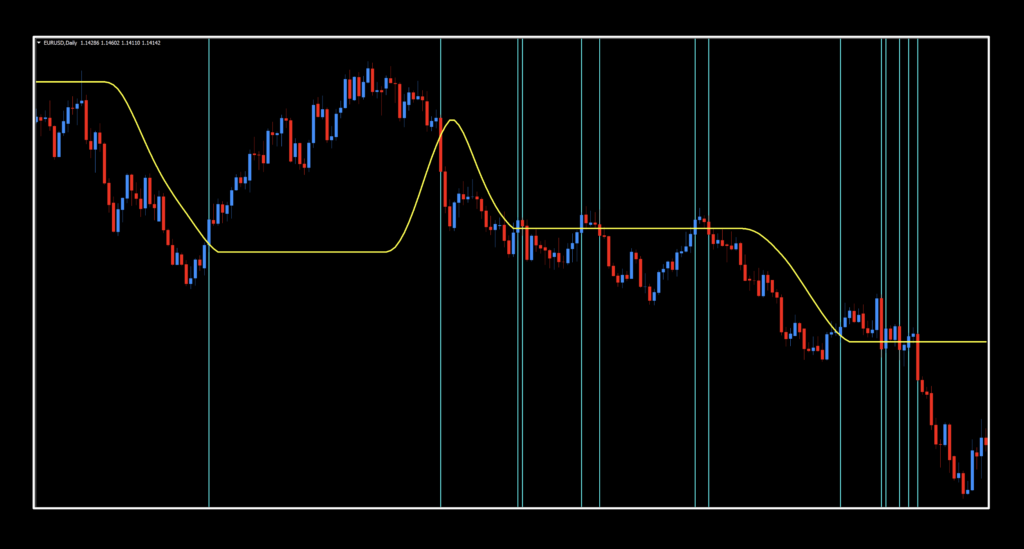
We did something a little different in this baseline blog. In order to better illustrate its capabilities, we used different settings and applied them to our chart, then marked off the signals. I’d say it did a fair bit better and created a chart which is a lot easier to read.
Settings
There are a grocery list of settings in this indicator and we used all of them. Some of them are a little unusual so pay attention to their functions. It took a little time to test, but felt it was worth it.
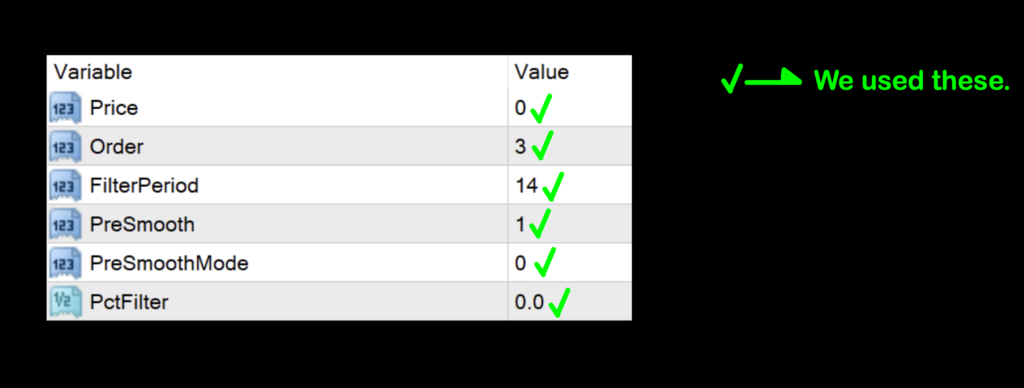
Price: Selects which price is used for the calculation. The default value is 0.
- Close=0
- Open=1
- High=2
- Low=3
- Median=4
- Typical=5
- Weighted=6.
Order: Selects the type of filter. The default is value is 3.
- 1 = Exponenial Moving Average
- 2 = 2-pole digital low-filter
- 3 = 3-pole digital low-pass filter
Filter Period: Controls the amount of smoothing. The default value is 14.
- Smaller values = Faster reaction/more signals.
- Larger values = Smoother line/slower reaction.
PreSmooth: Applies a moving average before the digital filter. A value of “1” means no additional smoothing. Higher values reduce noise before filtering but also increase lag. The default value is 1.
PreSmoothMode: Selects the type of moving average used for presmoothing. The default value is 0.
- 0 = SMA
- 1 = EMA
- 2 = SMMA
- 3 = LWMA
*This setting only matters if the PreSmooth setting is greater than 1.
PctFilter: Applies to adaptive noise filter. Rather than being a true percentage, it is a multiplier of the standard deviation of a recent filter movement. A value of 0 disables the feature, while higher values ignore increasingly smaller fluctuations and reduce whipsaws.
Daily Maintenance
Remember, once you’re ready to perform daily maintenance on your trades during the last 20–30 minutes of the trading day (1700 New York time), you’ll be presented with one of four options.
- Opening a trade.
- Closing a trade
- Maintaining a trade; i.e.
- Moving a stop loss level.
- Exiting a trade.
- Taking a pass (nothing to do).
Long:
- When price crosses and closes above the signal line.
Short:
- When price crosses and closes below the signal line.
Sum it Up
Now that we’ve gone through all the bits and pieces of this baseline, let’s get to the good part; testing. We spent some time in the lab and came away with metrics worth writing home about. One note we always like to bring up with baselines. They are not;
- Confirmation indicators
- Volume indicators
- Exit indicators (except in cases where prices reverse direction with extreme prejudice)
so their metrics should be taken as stand alone data.
Testing For Fun & Profit




We’ll Take It
Alrighty, let’s see what we have. By the looks of our testing data, it appears that this baseline does return some pretty good metrics. Naturally, we don’t pick the best or the worst and what works for you and in your algorithm may be different than what others are using. In any event, we were pretty happy with this and finding decent baselines don’t happen every day.
Resources
You’ll find this nicely appointed baseline indicator in the library for free, and it’ll be marked with “NEW” in red to help you locate it quickly. Be sure you’re subscribed to the Stonehill Forex YouTube channel, where we’ll show this pointy tool working over the last year’s data.
Don’t neglect the Advanced NNFX Course to help fast-track your trading education so you can shorten your learning curve to a fraction of what most traders must live through.
Our only goal is to make you a better trader.
*Our published testing results are based on the money management strategies employed by the NNFX system and depend on a variety of external factors that may differ between individuals and their specific broker conditions. No guarantees, trading recommendations, or other market suggestions are implied. Your results and subsequent trading activities remain solely your own responsibility.
BTW — Any information communicated by Stonehill Forex Limited is provided solely for educational purposes. The information contained in our courses, blogs, and on our website does not constitute investment advice or a general recommendation to invest. It is not intended to be, and should not be interpreted as, investment advice or a recommendation regarding any investment or trading activity. Any person who places trades, enters orders, or engages in any other form of trading or investment is solely responsible for their own investment decisions and does so at their own risk. Individuals should consult an independent financial adviser before making any investment decisions. Stonehill Forex Limited’s training courses, blogs, and other educational materials are provided for educational purposes only. Stonehill Forex Limited is not a financial advisory service and does not provide financial advice or make general investment recommendations.